Base4NFDI Birthday Campaign - July 2026

Banner Base4NFDI Birthday Campaign July

2026-07-30

In July we informed about another of our basic services: Terminology Services 4 NFDI (TS4NFDI). In the summary below you will see what the team has been working on, what is usable already, and where you can find further resources and materials.

TS4NFDI Community Support

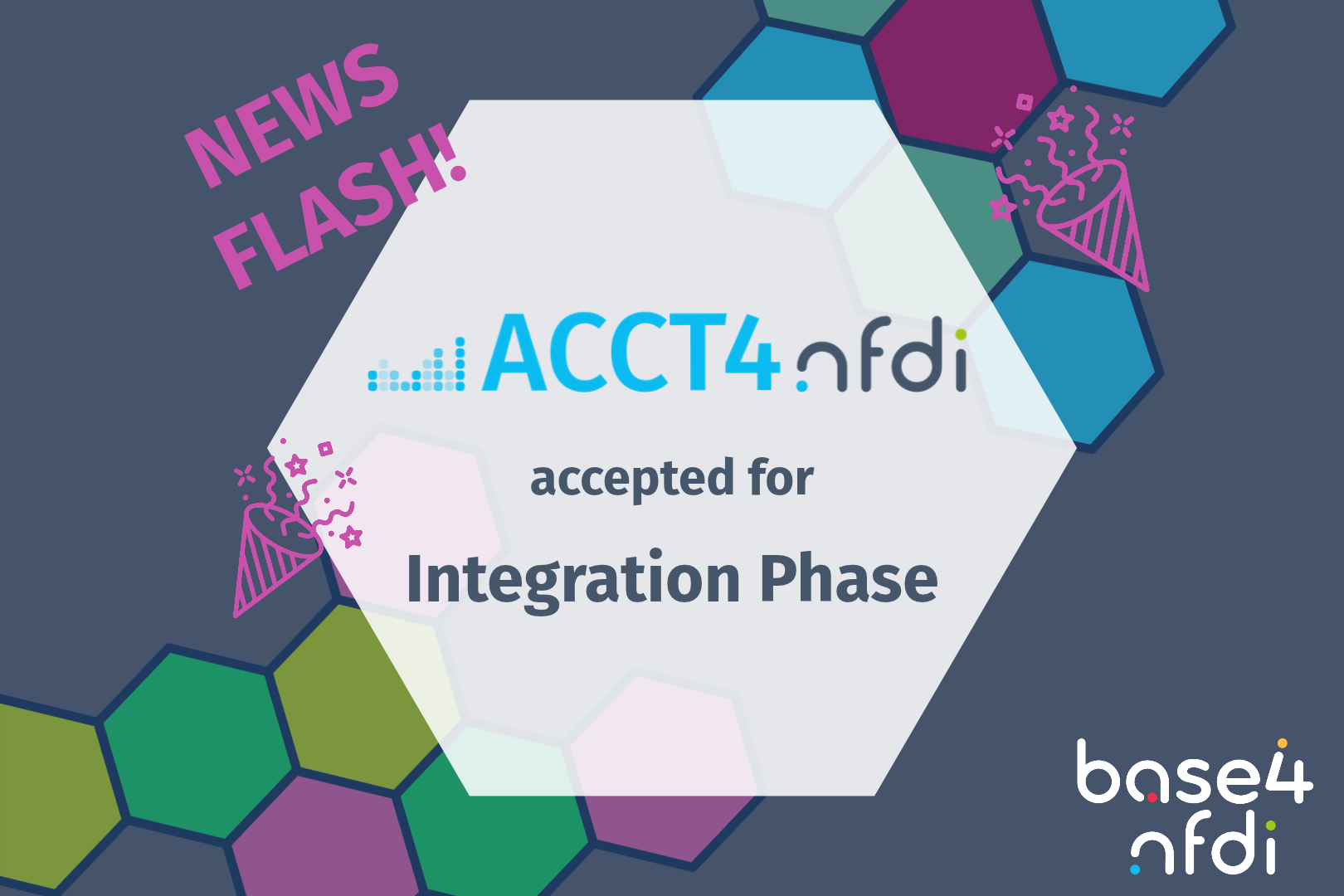
Firstly, we would like to highlight the fantastic news that the submission for the TS4NFDI Ramp-Up Phase has been approved by the Consortia Assembly. The service will enter the final phase of the Base4NFDI framework at the start of 2027.
During the Ramp-Up Phase, TS4NFDI will focus on establishing sustainable operational models and integrating its services into the long-term NFDI service portfolio. Activities include consolidating support, maintenance, monitoring, and analytics, while expanding terminology coverage and quality. The project will further promote integration into downstream services, engage with user communities through workshops and events, gather feedback for continuous improvement, and provide training resources.

At the moment, TS4NFDI is in their Integration Phase, which is expected to be completed by the end of the year. The goal of the Integration Phase is to further develop the service into a mature and functional solution that will have been adopted by an initial group of organisations and institutions for their day-to-day operations. TS4NFDI has made significant progress from concept to practical implementation and already provides a range of usable components, documentation, and community resources that support terminology management across the NFDI. 

The increasing adoption of the service within NFDI is demonstrated through its incubator programme. Numerous incubator projects are already completed or currently in progress, supporting the integration of TS4NFDI into services and infrastructures from different consortia. A recent example is the successful integration of TS4NFDI into the RADAR repository and its disciplinary services such as RADAR4Chem, RADAR4Culture, and RADAR4Memory. Researchers can now use standardised terms of terminologies directly when describing datasets, resulting in more consistent metadata and improved interoperability and reusability. The ongoing incubator programme continues to increase the use of terminology services and their features across the NFDI landscape.  

Another important element of TS4NFDI is its community engagement. As you can see in their event calendar, the project regularly organises and participates in workshops, conference sessions, hackathons, and training events that introduce researchers and developers to terminology services and their practical application. These events not only promote awareness of the service but also provide valuable opportunities to collect user feedback and foster collaboration with NFDI consortia. Together with the publicly available documentation, publications, and incubator programme (see above), these activities have helped establish a growing user community and contribute to the increasing dissemination of TS4NFDI throughout the NFDI ecosystem.

Teaser picture Base4NFDI Birthday Campaign about TS4NFDI Community Engagement

TS4NFDI Service Portal

TS4NFDI has made significant progress in establishing a comprehensive terminology service network for the NFDI, with several core components already available to users. The service provides a central Service Portal that offers access to the widgets of the Terminology Service Suite (TSS), an centralised API Gateway, a NFDI-wide Mapping Service, and an overview of all available Terminology Collections (set of terminologies that were created for a specific purpose or context). Together, these components enable researchers and service providers to discover, harmonise, map, and integrate terminologies across disciplines while facilitating the seamless integration of terminology functionalities into third-party applications .

As an important part of its technical infrastructure, TS4NFDI also offers a broad range of supporting resources. Comprehensive documentation is available for all major service components, including the overall architecture, the Service Portal, the TSS, the Mapping Service, and the API Gateway. Developers can access detailed implementation guidance, API documentation, and widget descriptions, making it easier to integrate TS4NFDI functionalities into existing services. In addition, the project maintains a growing collection of publications, presentations, and software resources that document both the scientific background and practical implementation of the service.

To familiarise yourselves with TS4NFDI and its offers, we recommend you watch the following videos:

We hope you enjoy the videos and testing of the offers TS4NFDI already made available to this point. For feedback, questions, or ideas to collaborate, do not hesitate to reach out to the team directly using their contact form.

Teaser picture for Base4NFDI Birthday Campaign about TS4NFDI Portal

Base4NFDI is now on Mastodon

Teaser picture announcement Base4NFDI Mastodon account

2026-07-27

We have good news to share: Base4NFDI is finally part of the Fediverse

There we'll share:
- Updates on our basic services
- Community events and workshops
- Insights from our framework
- News about publication and further materials

Follow us on https://nfdi.social/@base4nfdi and maybe leave us some nice welcome comments.

We're looking forward to connecting with researchers, infrastructure providers, and everyone interested in research data management and Open Science.

Call for Contributions UC4B2026: Deadline is extended

CfC UC4B 2026 Extension

2026-07-22

Great news! We extend the deadline for submissions for our 3rd Base4NFDI User Conference
We warmly invite you to contribute to the conference. Please submit your abstract until July 29, 2026.

The comprehensive Call for Contributions can be found here: https://events.gwdg.de/event/1337/abstracts/

At least one author per accepted contribution is expected to attend in person.

Join us to shape the next generation of Base4NFDI services and connect with experts advancing research data infrastructures across disciplines. 

Contact: This email address is being protected from spambots. You need JavaScript enabled to view it.
Conference Website: https://events.gwdg.de/event/1337/overview

Base4NFDI Demo Session: Accounting4NFDI

Teaser picture of Base4NFDI Demo Session with Accounting4NFDI

2026-07-14

We are excited to continue our Base4NFDI Demo Session series!

These sessions showcase our basic services live, giving you a hands-on view of specific tools, highlighting practical workflows, and allowing direct interaction with the developers.

Next Session:

Accounting4NFDI – Demo Session

Tuesday, 28 July 2026
1:30–2:30 PM CEST

For researchers, infrastructure providers, service operators, developers, consortium coordinators, and everyone interested in resource accounting and monitoring within the NFDI.

About Accounting4NFDI

Accounting4NFDI aims to develop a federated accounting framework for collecting, attributing and reporting resource usage across the National Research Data Infrastructure (NFDI). The project builds on existing expertise and tools from national and European initiatives while analysing standards and protocols for resource accounting.

What to expect

Join the Accounting4NFDI team to learn more about the project's motivation and vision, gain first insights from the ongoing requirements analysis, explore existing accounting solutions, and get a first look at the initial prototype.

The session is intended as an open exchange with the community to discuss requirements, existing approaches, and future directions for federated resource accounting within the NFDI.

More information & registration: BASE4NFDI Event Page

Direct Zoom registration: Base4NFDI Demo Session: Accounting4NFDI

The event will be recorded and will be available here.

Base4NFDI Birthday Campaign - June 2026

Banner Base4NFDI Birthday Campaign in June

2026-07-08

In June our Birthday Campaign focused on Base4NFDI per se. We took a a closer look at our service definition – what is a basic service, and what is it not? 

What are Basic Services in Base4NFDI?

As the development of basic services progresses, we would like to clarify how we define the meaning of basic services and how those relate to community or domain-specific services.

Basic Services are designed to create added value across the NFDI landscape. Their goal is to address common needs that are shared by many consortia and also communities outside NFDI. To achieve this, basic services aim to gather requirements from a broad range of disciplines and stakeholders.

Importantly, there is no obligation for consortia or projects to use these basic services. They are offered as an option that communities can adopt if they provide value for their specific use cases.

Base4NFDI supports the development of those services by building on existing open-source solutions wherever possible. Currently, the term basic services refers primarily to services that are being developed within the Base4NFDI context.

Basic Services vs. Domain Services

The distinction between basic services and domain-specific services is often misunderstood. Therefore, we use this opportunity to clarify the difference between the two:

Domain services are typically developed to meet the requirements of a particular research community or discipline. While many of these services can also be used beyond their original domain, their development is usually guided by the needs of their primary community.

Basic services, however, follow a different development approach. From the beginning, they seek to incorporate requirements from multiple communities and consortia. This broader perspective has an impact on their design, integration strategy, and governance. This being said, once the services are operational, there is no fundamental technical difference between a basic service and a domain service. Both can be used across disciplines. 

In short: The main distinction lies in the origin and development process of the two service groups. As a result, basic services are often positioned to serve a wider range of users and use cases than domain services.

Integration as a Core Objective

A key goal of basic services is to facilitate integration with domain services through shared interfaces, workflows, and interoperable architectures. This integration is not a one-way process. Input, requirements, and connections from domain services are equally important. The ongoing integration activities and our 5-Step Integration Plan reflect this collaborative approach.

Why Central Services?

In some cases, centrally offered services can be operated more efficiently than multiple local deployments. However, efficiency is only one consideration among many. Community requirements, sustainability, interoperability, and flexibility remain equally important factors when deciding how services are developed and provided.

Ultimately, basic services are intended to support broad user groups across NFDI, complement existing domain services, and foster a more connected and interoperable research data infrastructure.

Overview Basic Service Definition for Base4NFDI Birthday Campaign

What is NOT a Basic Service?

While you could learn all about what a basic service is and how it is defined above, we now want to clearly state what a basic service is NOT:

Overview what is not a Basic Service for Base4NFDI Birthday Campaign

We use cookies
...but only the cookies automatically set by Joomla for the session, which are not marketing cookies and cannot be avoided and are data protection compliant. Apart from this, this website does not use any other first-party or third-party cookies.