Propose to us!

Base4NFDI Demo Session: RDMTraining4NFDI

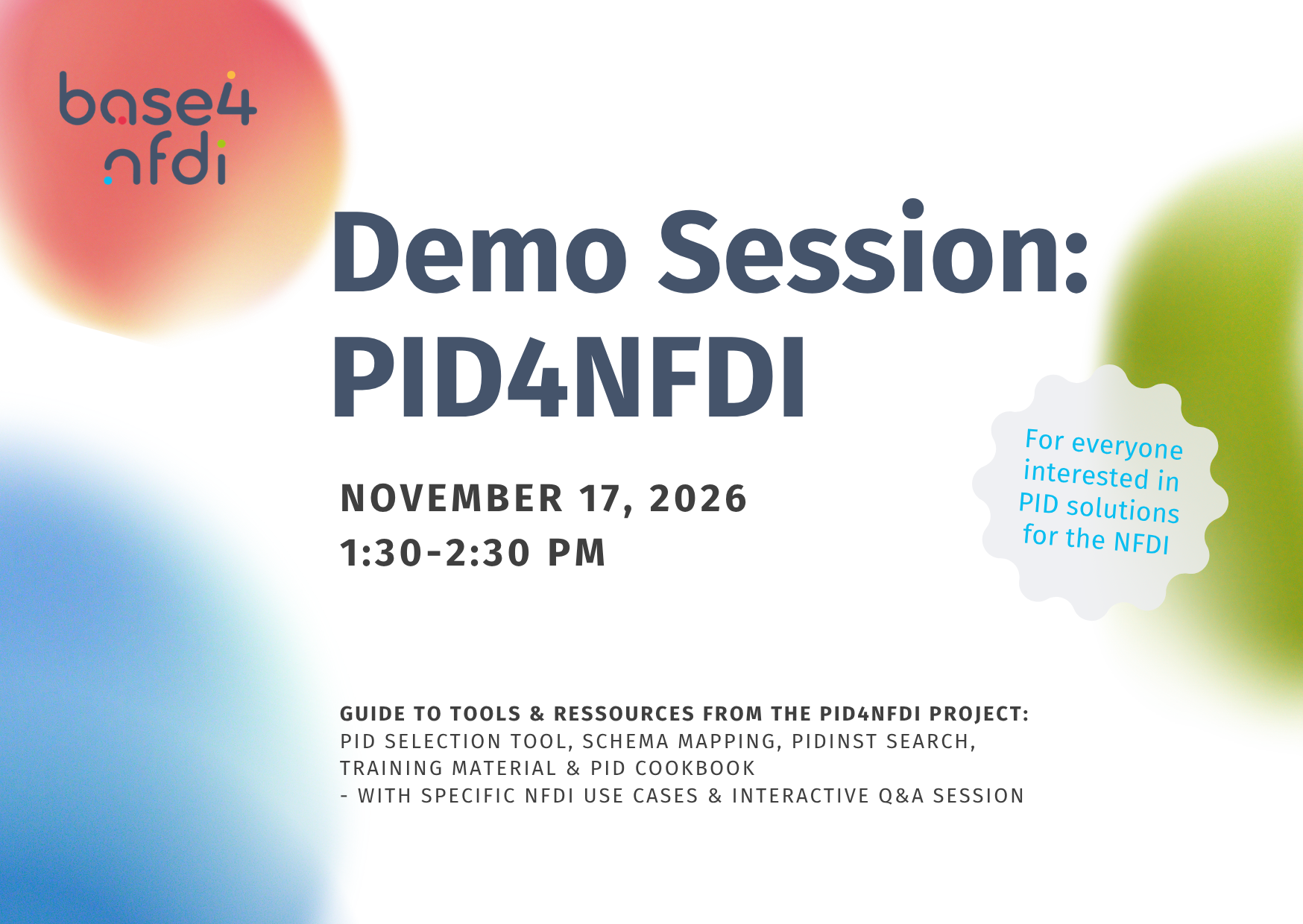
picture with save the date from Base4NFDI Demo Session with RDMT4NFDI

2026-04-02

We are excited to continue our Base4NFDI Demo Session series! These sessions showcase our basic services live, giving you a hands-on view of specific tools, highlighting practical workflows, and allowing direct interaction with the developers.

Next Session: RDMT4NFDI – Demo Session
Date: Tuesday, 14 April 2026
Time: 1:30 – 2:30 PM CEST

About RDMT4NFDI:
RDMT4NFDI aims to develop and provide training in research data management (RDM) within tthe NFDI. The service focuses on creating modular training materials, proven training formats, and didactic concepts that can be adapted by consortia for their communities. In addition, certification approaches are explored to support quality assurance and document acquired RDM skills.

What to expect:
Join the RDMT4NFDI demo session with Sina Bock (TH Köln) and gain insights into the analysis of training materials and formats across NFDI. The session will explore how quality indicators can be derived and applied to strengthen RDM training. It will show you how to:

  • Use findings from training material analysis to guide consistent, high-quality training
  • Understand quality indicators for accreditation and certification
  • Engage in discussion and ask questions during the interactive Q&A session

More information & registration: BASE4NFDI Event Page
Direct Zoom registration: Base4NFDI Demo Session: RDMT4NFDI

The event will be recorded and will be available later here.

We look forward to your participation!

Fireside Chat Interview Series 2026

Teaser picture of the Base4NFDI Fireside Conversations with thought leaders on RDM infrastructure

2026-04-02

Fireside Chat Interview Series 2026

Conversations on Sustainable Research Data Management

Join our fireside chat series featuring seasoned leaders from research data infrastructures (RDI) as they share hard‑won insights on building, running, and sustaining reliable data ecosystems. Each session will uncover practical lessons for long-term sustainability governance, federated services, community buy-in, and long‑term sustainability – designed to inspire the current and future RDI leaders.

Base4NFDI is a key part of Germany’s efforts to develop sustainable RDM services and has several activity lines exploring how to provide long-term perspective to its own cross-discipline open science services (infrastructures). The series is co-organised by the Research Data Alliance (RDA) and the Australian Research Data Commons (ARDC) which builds the essential bridges to the global community on RDM challenges and infrastructures.

The 45-minute interviews, held by Najla Rettberg, Coordinator of Base4NFDI, will engage with timely topics, for example:

  • Sustainability: Transitioning from project to permanent operating models
  • Community Buy-In: Enhancing user engagement and uptake
  • Governance: Finding the right fit when it comes to business models and financing approaches
  • Long-Term Impact & Scalability: The role of digital sovereignty and AI

All sessions are open to those who register, they will be recorded, with a comprehensive report of key lessons and summaries to be published afterward.

Dates of the Fireside Interviews: 

  • 28 April 2026 at 15h CEST (13h UTC +2)
  • 18 June 2026 at 10h CEST (8h UTC +2)

Register here: https://uni-goettingen.zoom.us/webinar/register/WN_uROpjU9FQ_KGM2Wt2Vu2bA#/registration

Don’t miss this opportunity to be part of a global dialogue shaping the future of research data management. Register now and join the conversation!

Our first conversation on 28 April at 15h CEST (13h UTC +2) will be with Michael Schull, M.D., the CEO of the Canadian Data Alliance.

Picture of Michael Schull from Canadian Data Alliance

Photo Credit: Digital Research Alliance of Canada

About Michael: 

As CEO of the Digital Research Alliance of Canada, Michael leverages his extensive experience in building national and international research and data partnerships, and organizational growth and sustainability to support the establishment of a researcher focused, accountable, agile, strategic and sustainable digital research infrastructure (DRI) ecosystem in Canada.

About the Digital Research Alliance Canada: https://www.alliancecan.ca/en/about 


Rosie Hicks, CEO of the Australian Research Data Commons (ARDC), will share her insights in a second fireside chat on 18 June 2026 at 10h CEST (8h UTC +2). 

Picture of Rosie Hicks, CEO of the Australian Research Data Commons

Photo Credit: Australian Research Data Commons

About Rosie: 

Rosie Hicks is the Chief Executive Officer of the Australian Research Data Commons (ARDC). The ARDC is a sector-wide initiative enabled by the Australian Government’s National Collaborative Research Infrastructure Strategy (NCRIS) to provide Australian researchers with competitive advantage through data. The ARDC’s mission is to accelerate research and innovation by driving excellence in the creation, analysis and retention of high-quality data assets. Rosie has expertise and extensive knowledge of the Australian research infrastructure sector, and leadership experience including as the inaugural CEO of the Australian National Fabrication Facility (ANFF). Her career, spanning Japan, UK and Australia, includes every aspect of scientific instrumentation from product development and technical marketing to the management of multi-user facilities, working in environments that cross academic and industry domains.

About ARDC: https://ardc.edu.au/  

Base4NFDI Birthday Campaign - March 2026

Teaser picture for the Base4NFDI Birthday Campaign to celebrate the third birthday of the project

2026-03-31

Time to celebrate: In March 2026, we've reached a major milestone with Base4NFDI's third birthday! Over the past three years we’ve come a long way and made some significant progress. Therefore, we would really like to share that progress with you and the whole community. 

As a joint initiative of all 26 consortia, we’ve established a central framework for developing cross-cutting, reusable basic services that benefit all scientific communities within NFDI. Right now, Base4NFDI is funding the development of nine basic service candidates: IAM4NFDI, PID4NFDI, TS4NFDI, DMP4NFDI, Jupyter4NFDI, KGI4NFDI, nfdi.software, RDMTraining4NFDI, and Accounting4NFDI. These cover a broad range of areas like research data management, infrastructure access, and knowledge sharing across all NFDI domains. Although most of our services are still in early phases of their lifecycle, they are already providing measurable benefits to researchers and infrastructure operators. And since we’re really proud of that, we are going to show you some of the incredible outcomes from the project and from the basic services each month over the course of this year! 

Base4NFDI Framework

Even after three years, we still get asked a lot of questions about what Base4NFDI is and what we're doing. As a quite complex infrastructure, we would like to use this opportunity to go back to the basics.

The Base4NFDI process brings together multiple stakeholders that have agreed on the need for basic services. Proposals for basic service candidates are submitted via an NFDI section to ensure the need of various scientific disciplines (see submission process). First, we formally check all proposals, then open a four-week voting phase where the NFDI consortia can state their support. To advance and receive funding, proposals must meet quorum thresholds (25% Initialisation phase, 50% Integration phase, 75% Ramp-up phase). Once met, the 13-member Technical Expert Committee (TEC) reviews each proposal for technical quality, interoperability, partner suitability, and financial soundness. All recommendations, reviews, and votes are then forwarded to the Consortia Assembly for final funding decisions (see decision making process).

After the funding is approved, the four Base4NDI Task Areas and the team of Service Stewards begin their work. Task Area 1 (Service Requirements, Design, and Development) supports services during the Initialisation phase by helping to gather requirements, evaluate software, and define service designs. Task Area 2 (Service Integration and Ramping-up for Operation) supports basic services during their Integration and Ramp-up phases, with a focus on improving software maturity, user acceptance, and sustainability. Task Area 3 (Service Coherence Processes and Monitoring) goes back to support the NFDI sections in identifying potential basic services, while monitoring the ongoing processes of the framework. Task Area 4 (Project Governance) coordinates the decision-making processes and Base4NFDI as a whole, including project, financial and funding contract management. It also links Base4NFDI to the NFDI association bodies and is responsible for outreach, policy briefings, advice on user enablement and training, and the external evaluation of Base4NFDI.

These activities go along with the special role Base4NFDI has pioneered: Service Stewards (SERs). SERs are the link between the teams that develop basic services and the NFDI Sections and Consortia. They translate what the community needs into real technical and organisational requirements for services and their phases. SERs make services more effective by organising and checking how they are developed and introduced.

Over the past three years, considerable efforts have been made within Base4NFDI to adapt the framework to the varying needs of the basic services. As requirements for services change with each development phase, our entire team is working constantly to provide the developer teams with the best possible support and create helpful materials. All outputs are, of course, available and usable not only for the services, but also for the whole community.

Graphic of the Base4NFDI submissions and decision framework with all invlved stakeholders

Base4NFDI Community Engagement

Our framework depends on the support and feedback from the NFDI community that's transferred via the NFDI Sections and the Consortia Assembly. But even more importantly, our basic services are developed to be usable in all the disciplines represented by the 26 NFDI consortia. Therefore, it’s absolutely essential to engage regularly with the different communities to ensure an effective development along the needs of researchers and institutions within NFDI.

This engagement happens in lots of different activities, e.g. outreach, training, and networking. Through regular training sessions with the services and the publication of helpful materials, which are regularly updated on Zenodo, we increase usability and support the dissemination of expertise. A really important part of community engagement is taking part in external events, where we make sure our contributions are tailored to each community. We also organise our own events, like roadshows (2024 and 2025), demo sessions, and user conferences (UC4B 2024 and UC4B 2025). To further boost visibility, we also run regular social media and website posts, as well as a newsletter every other month. 

Within the last three years Base4NFDI gathered some quite impressive numbers* regarding our activities to engage with the communities:

 Graphic with a selection of numbers, which show the involvement of Base4NFDI with its community.

However, there is still work to be done and we are continuously improving our engagement activities. 

*These numbers do not include the activities of the basic services. The total number of views of the roadshow and explainer videos is based on the sum of all the videos that have been uploaded to the Base4NFDI playlist on the official NFDI YouTube channel. These figures were obtained via YouTube statistics.

DMP4NFDI - 2nd Call for Incubator Projects

Teaser picture for a call for incubators from DMP4NFDI

2026-03-24

We invite you to participate in the DMP4NFDI Incubator, an initiative that supports the development and integration of Data and Software Management Plan services within the NFDI community.
The DMP4NFDI service offers collaboration opportunities for consortia at different stages of their research data management activities.

You can apply for:

  • RDMO hosting - set up a customised RDMO client for your consortium,
  • Template development - co-develop DMP or SMP templates tailored to your community’s needs
  • receive assistance in integrating RDMO with other services relevant to your consortium
  • Support for training & outreach activities

Get in touch with the team, to discuss your idea and to evaluate necessary resources.

To propose an incubator project, please complete the short application template outlining your goals, team, and expected outcomes, and submit the template by April 22.

Submission open: March 23 - April 22, 2026

Template: download the Template as .pdf, or as .docx and .odt here.

Submit template to: This email address is being protected from spambots. You need JavaScript enabled to view it.
DMP4NFDI website: https://dmp.services.base4nfdi.de

More information and explore current projects: https://dmp.services.base4nfdi.de/incubator/


TEC: Update 2026

TEC-logo

2026-03-02

Three TEC members will be stepping down this year: Henriette Senst, Anne Lipp, and Hannes Thiemann. We wish all the best and continued success in the future.

In January 2026, the consortium meeting agreed that Base4NFDI would recruit three people from a list submitted by Base4NFDI to replace outgoing members of the TEC. The following candidates have accepted and will from Round 10 onwards begin joining the TEC:

  • Prof. Dr. Heike Neuroth, professor at the University of Applied Sciences Potsdam
  • Prof. Dr. Sarah Neuwirth, professor at JG University Mainz
  • Dr. Nanette Rißler-Pipka, Max Weber Stiftung

We would like to thank our soon-to-be former members for their committed and diligent engagement and look forward to working with our new members in the future.