
2026-03-31
Time to celebrate: In March 2026, we've reached a major milestone with Base4NFDI's third birthday! Over the past three years we’ve come a long way and made some significant progress. Therefore, we would really like to share that progress with you and the whole community.
As a joint initiative of all 26 consortia, we’ve established a central framework for developing cross-cutting, reusable basic services that benefit all scientific communities within NFDI. Right now, Base4NFDI is funding the development of nine basic service candidates: IAM4NFDI, PID4NFDI, TS4NFDI, DMP4NFDI, Jupyter4NFDI, KGI4NFDI, nfdi.software, RDMTraining4NFDI, and Accounting4NFDI. These cover a broad range of areas like research data management, infrastructure access, and knowledge sharing across all NFDI domains. Although most of our services are still in early phases of their lifecycle, they are already providing measurable benefits to researchers and infrastructure operators. And since we’re really proud of that, we are going to show you some of the incredible outcomes from the project and from the basic services each month over the course of this year!
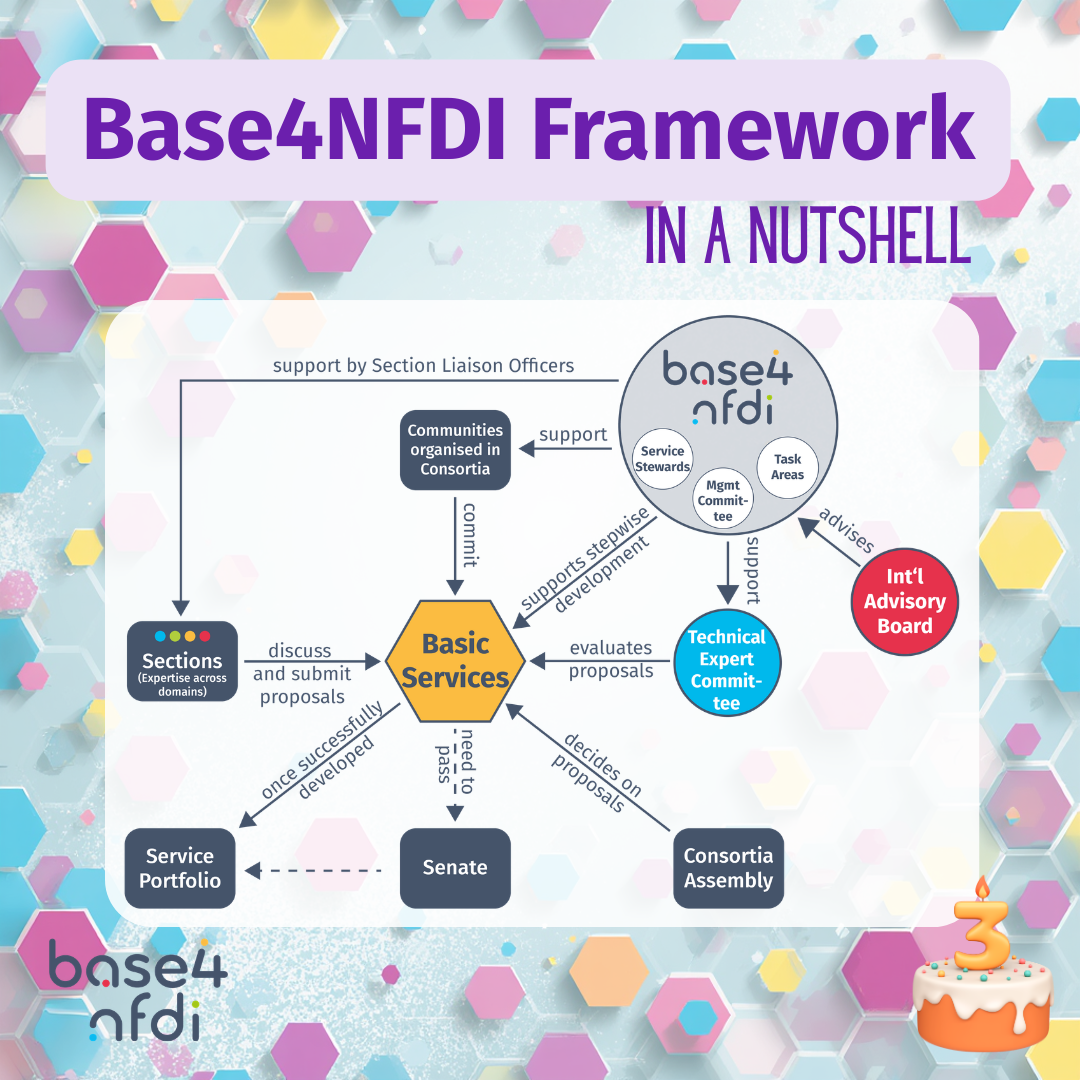
Base4NFDI Framework
Even after three years, we still get asked a lot of questions about what Base4NFDI is and what we're doing. As a quite complex infrastructure, we would like to use this opportunity to go back to the basics.
The Base4NFDI process brings together multiple stakeholders that have agreed on the need for basic services. Proposals for basic service candidates are submitted via an NFDI section to ensure the need of various scientific disciplines (see submission process). First, we formally check all proposals, then open a four-week voting phase where the NFDI consortia can state their support. To advance and receive funding, proposals must meet quorum thresholds (25% Initialisation phase, 50% Integration phase, 75% Ramp-up phase). Once met, the 13-member Technical Expert Committee (TEC) reviews each proposal for technical quality, interoperability, partner suitability, and financial soundness. All recommendations, reviews, and votes are then forwarded to the Consortia Assembly for final funding decisions (see decision making process).
After the funding is approved, the four Base4NDI Task Areas and the team of Service Stewards begin their work. Task Area 1 (Service Requirements, Design, and Development) supports services during the Initialisation phase by helping to gather requirements, evaluate software, and define service designs. Task Area 2 (Service Integration and Ramping-up for Operation) supports basic services during their Integration and Ramp-up phases, with a focus on improving software maturity, user acceptance, and sustainability. Task Area 3 (Service Coherence Processes and Monitoring) goes back to support the NFDI sections in identifying potential basic services, while monitoring the ongoing processes of the framework. Task Area 4 (Project Governance) coordinates the decision-making processes and Base4NFDI as a whole, including project, financial and funding contract management. It also links Base4NFDI to the NFDI association bodies and is responsible for outreach, policy briefings, advice on user enablement and training, and the external evaluation of Base4NFDI.
These activities go along with the special role Base4NFDI has pioneered: Service Stewards (SERs). SERs are the link between the teams that develop basic services and the NFDI Sections and Consortia. They translate what the community needs into real technical and organisational requirements for services and their phases. SERs make services more effective by organising and checking how they are developed and introduced.
Over the past three years, considerable efforts have been made within Base4NFDI to adapt the framework to the varying needs of the basic services. As requirements for services change with each development phase, our entire team is working constantly to provide the developer teams with the best possible support and create helpful materials. All outputs are, of course, available and usable not only for the services, but also for the whole community.
Base4NFDI Community Engagement
Our framework depends on the support and feedback from the NFDI community that's transferred via the NFDI Sections and the Consortia Assembly. But even more importantly, our basic services are developed to be usable in all the disciplines represented by the 26 NFDI consortia. Therefore, it’s absolutely essential to engage regularly with the different communities to ensure an effective development along the needs of researchers and institutions within NFDI.
This engagement happens in lots of different activities, e.g. outreach, training, and networking. Through regular training sessions with the services and the publication of helpful materials, which are regularly updated on Zenodo, we increase usability and support the dissemination of expertise. A really important part of community engagement is taking part in external events, where we make sure our contributions are tailored to each community. We also organise our own events, like roadshows (2024 and 2025), demo sessions, and user conferences (UC4B 2024 and UC4B 2025). To further boost visibility, we also run regular social media and website posts, as well as a newsletter every other month.
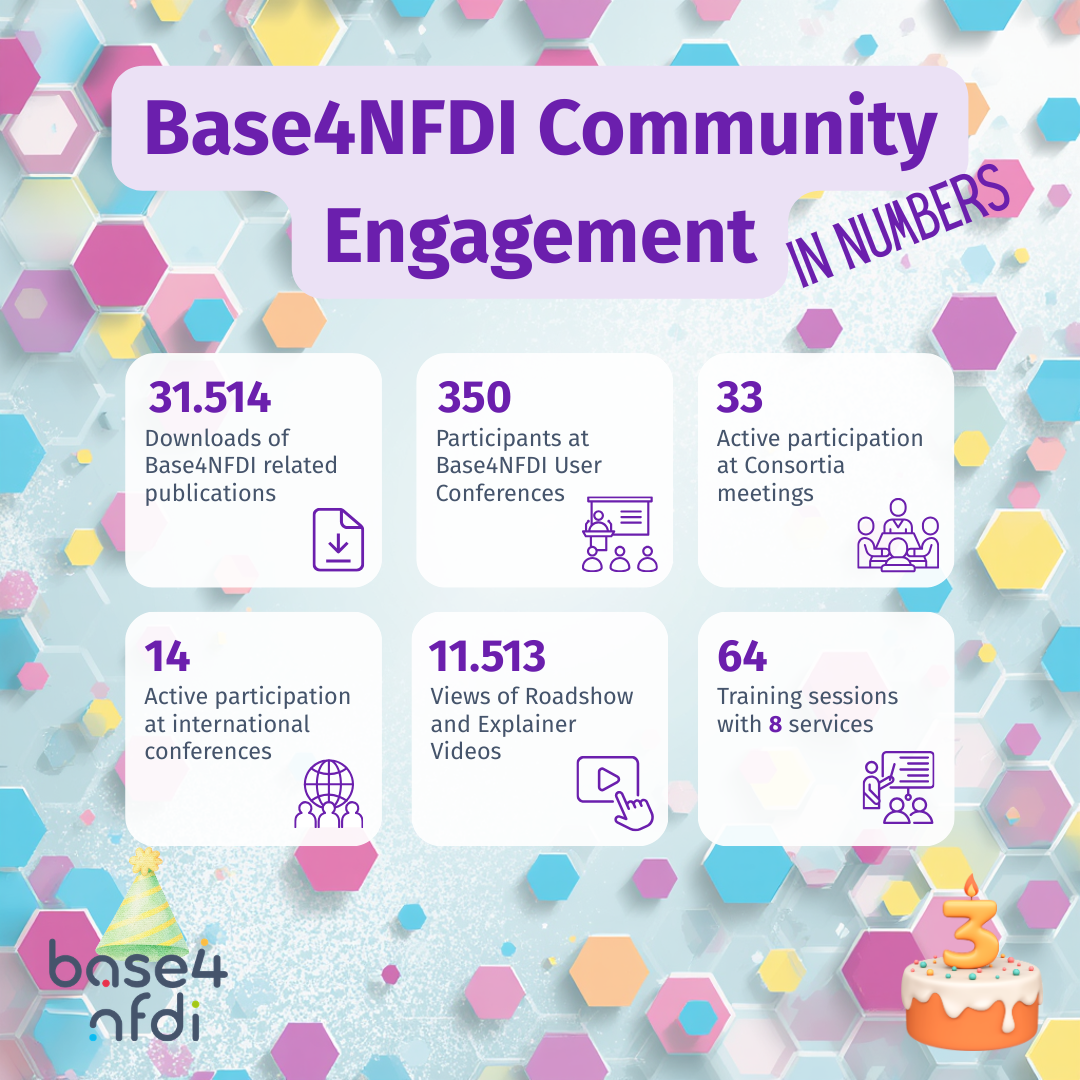
Within the last three years Base4NFDI gathered some quite impressive numbers* regarding our activities to engage with the communities:
However, there is still work to be done and we are continuously improving our engagement activities.
*These numbers do not include the activities of the basic services. The total number of views of the roadshow and explainer videos is based on the sum of all the videos that have been uploaded to the Base4NFDI playlist on the official NFDI YouTube channel. These figures were obtained via YouTube statistics.
