
2026-08-24
In August, we shared information about another of our basic services: Jupyter4NFDI. In the summary below you will see what the team has been working on, what is usable already, and where you can find further resources and materials.
Juypter4NFDI – An introduction
Jupyter4NFDI is an online, browser-based Jupyter platform for researchers and users in the NFDI community. It gives you a place to run notebooks and work with data, simulations, or machine learning without needing to set up a full local environment first. On the team’s website you cannot only learn all about their intentions and recent progress, but it also points users to different JupyterHub services and helps them choose the right one for their needs.
The service can be used via a JupyterHub that is hosted by Forschungszentrum Jülich (FZJ). For user authentication, Jupyter4NFDI relies on the NFDI Infrastructure Proxy. To log in and use the service, you have to select a suitable AAI from a list of options. Furthermore, the service…
- Lets you access Jupyter notebooks in the browser.
- Connects you to cloud resources for data analysis, training, and computational work.
- Supports reproducible research by making it easier to use the same environment across users and workshops.
To get started, you visit the hub, sign in with a supported identity provider, choose a system, and launch your workspace. The site is meant to make it simple to start working quickly, especially if you are part of an NFDI consortium or affiliated communities.
Jupyter4NFDI also offers special tools for running workshops. Instructors can create controlled environments, manage participant access, share storage, and even allow tutors to join sessions for live help.
To sum it up… If you need a ready-to-use Jupyter environment for research, training, or collaborative data work, Jupyter4NFDI and its informative website are exactly what you are looking for. It focuses on making access easy, keeping setups consistent, and supporting both individual users and organised workshops.
Conclusively, we want to draw your attention to our Demo Session (May 2026), where Jupyter4NFDI showed the progress they made so far.
The JupyterHub & incubator projects
Like you read before, Jupyter4NFDI provides a federated JupyterHub that enables accessible, reproducible, and collaborative research workflows and connects resources from NFDI partners to a central NFDI JupyterHub. By connecting different computing resources through a central access point, the service simplifies the use of Jupyter environments while supporting FAIR and open science principles. A major advantage of Jupyter4NFDI is that it benefits not only researchers but also resource providers.
For researchers, Jupyter4NFDI offers a flexible environment for data analysis, teaching, and collaboration. Users can execute notebooks directly from code repositories, create shareable links to their work, collaborate with colleagues in real time, and run their own container images to tailor the environment to their specific needs. The platform also supports trusted training and teaching by providing configurable workshop environments and fostering a growing community that shares knowledge, best practices, and reusable resources.
Detailed information about how researchers can use Jupyter4NFDI can be found in their extensive documentation on https://nfdi-jupyter.de/.
Resource providers benefit from a scalable architecture that allows them to connect their local computing infrastructure to the central Jupyter4NFDI Hub. Through the in-house developed JupyterHub Outpost, providers can integrate their resources while retaining control over their infrastructure. At the same time, they benefit from a centralised user management, reducing administrative effort and making their resources accessible to a broad research community.
More information about the JupyterHub Outpost architecture, its installation and configuration can be reviewed here: https://nfdi-jupyter.de/providers/.
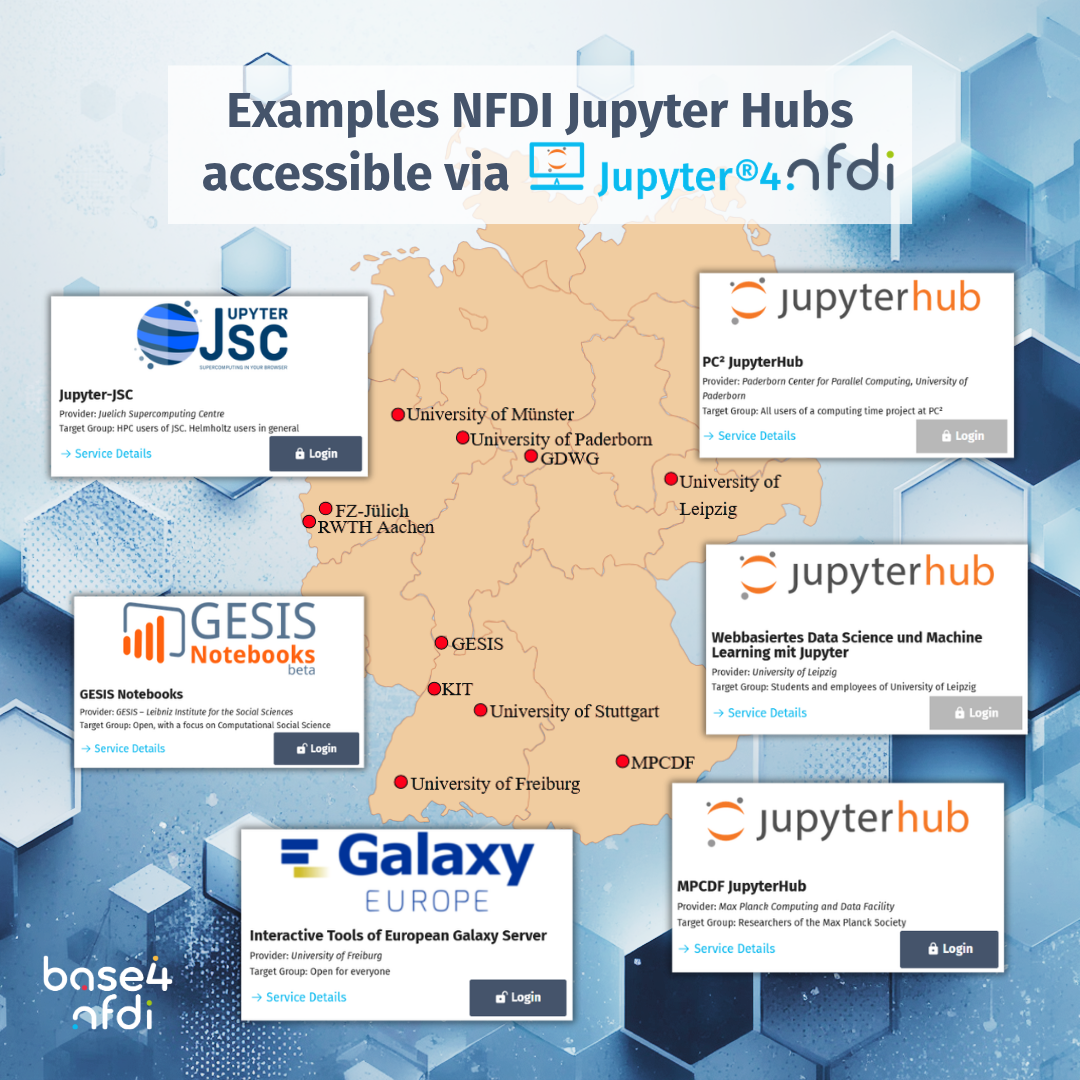
The fact that Jupyter Notebooks are a practical tool for researchers in various disciplines is demonstrated by the growing number of Jupyter Hubs already accessible via Jupyter4NFDI. Currently, 11 providers host 12 Jupyter services. A list of all NFDI JupyterHubs can be accessed here: https://nfdi-jupyter.de/hubs/
Furthermore, Jupyter4NFDI is adopted across multiple NFDI consortia like NFDI4DataScience, DataPLANT, NFDI4Bioimage and NFDI4ING, not only via its Hubs but also through Incubator projects. An example here is MONAPipe in Text+: https://textplus.pages.gwdg.de/collections/mona-pipe/. It provides natural-language-processing tools for German, implemented in Python/spaCy; additionally, MONAPipe adds specific custom components and models for Digital Humanities and Computational Literary Studies. Jupyter4NFDI, thus, enables users to directly access Python resources and workflows without the need for local software installations via accessing shared environments through JupyterHub instances.
While this is only one example of a successful incubator project, we would like to point you to an overview of the service’s completed and ongoing incubators: https://github.com/NFDI-Jupyter/services/discussions
And for some general information about the incubator endeavours, including an FAQ list, please visit: https://base4nfdi.de/projects/incubators
Should you have any questions, do not hesitate to reach out to the team via